
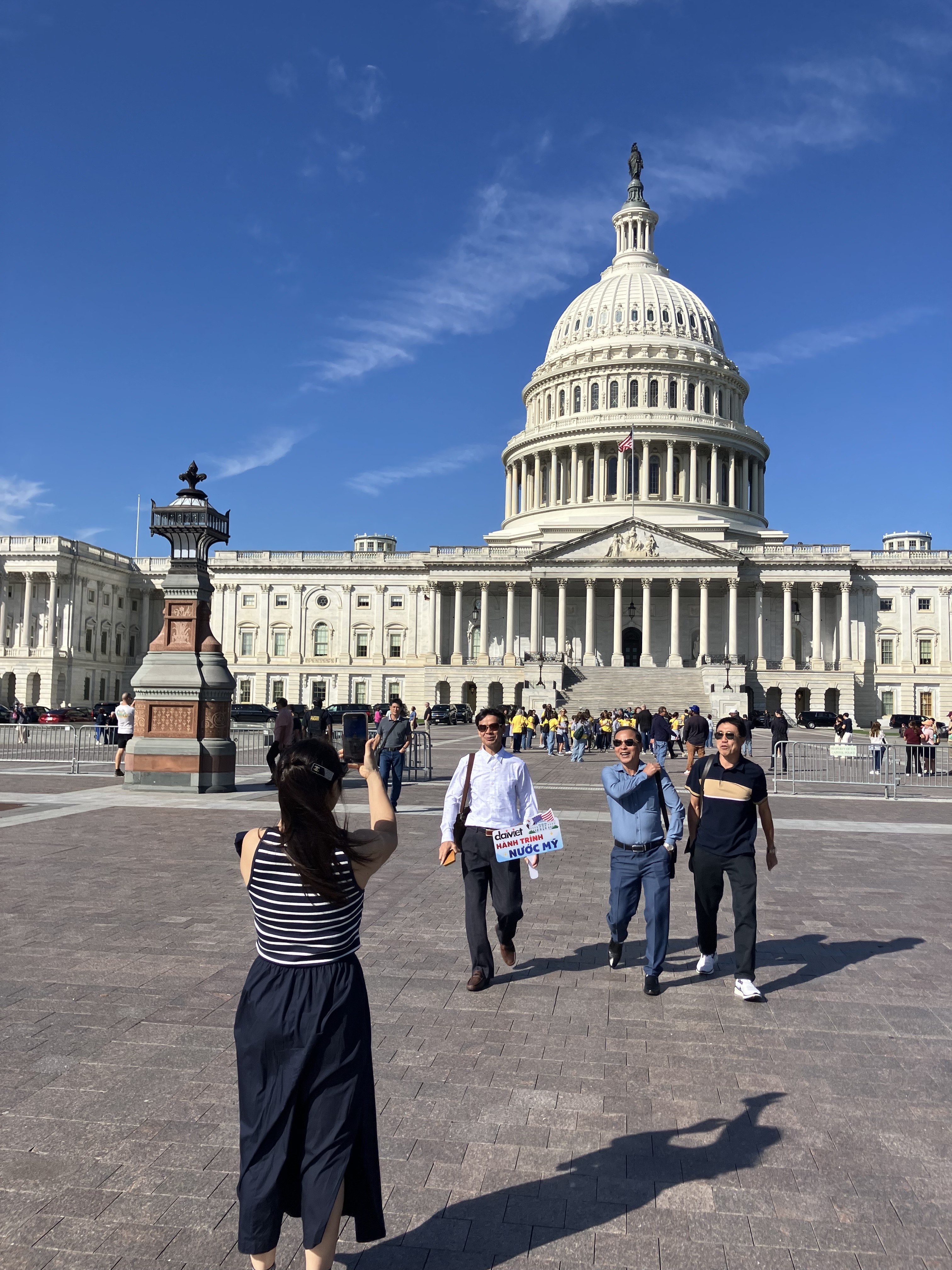
Wednesday October 15 is seeing partly sunny skies in Washington D.C. on a 70-degree fall day, but federal shutdown negotiations are filling the political landscape with clouds, as one party continues to blame the other.
Both Democratic and Republican leadership in the House of Representatives exchanged press releases October 15, criticising the other party for the shutdown, yet expressing no inward accountability for the situation.
In a press release today, October 15, House Minority Leader Hakeem Jefferies cited his conversation with MSNBC’s Lawrence O’Donnell yesterday, where he stated: “…Our view and our position has been very clear that we need to address the Republican healthcare crisis that is devastating people all across the country, whether that’s working-class America, rural America, urban America, small-town America, the heartland of America and Black and brown communities throughout America.”
House Speaker Mike Johnson lauded a proposed litany of Republican accomplishments in his press release today, stating, “While Democrats focus on political theater and shutting down the government, Republicans are producing real results across every front — at home and abroad.”
He contended that the Republican Party is restoring peace abroad, and law and order and prosperity in the United States.
The Democratic Party, for its part, floated a $1.5 Trillion adjustment to the already-passed OBBBA (One Big Beautiful Bill Act), which, if agreed to back in September, may have kept the federal government open. The adjustment appears to have included pork, according to House Speaker Johnson. But most of the adjustment related to rescinding Medicaid and Medicare cuts.
Around $1 Trillion of the Democrat budget bill adjustment would go toward repealing cuts and restrictions, and new working requirements for American citizens who receive Medicaid and Medicare.
But Democrats are focusing on rescinding the elimination of Affordable Care tax credits as their central argument for standing firm. The elimination of the tax credit is expected to cause around 22 million Americans to be faced with health care bills that will dramatically increase, but the credits as a whole are actually limited to $350 billion of the Democrat’s $1.5 Trillion proposed OBBBA adjustment.
The entire Democratic proposal would potentially increase the financial cost of the OBBBA by well over 25 percent, where the Republican-led Congress has already extended $4 Trillion of debt over the next decade.
The average American family using the Affordable Care Act saved $705 annually from the tax credit in 2024, according to the Kaiser Family Foundation. But one citizen, a former college roommate of Fifty Star Press’s editor, reported that after investigating the numbers, he expects his son’s monthly bill to go from $400 to $800. His son has a serious chronic health condition, and the man already works two jobs to maintain his household’s budget.
Republican arguments for not negotiating on the appropriations start on the false premise that foreigners in the United States illegally will have the opportunity to enjoy the affordable care tax credit too–even though such an act is already illegal under federal U.S. Code 18082 , and every ACA recipient is vetted electronically upon their application.
Any individual entering a hospital emergency room is entitled through federal law to life-saving medical care up to the point where they are physically stabilized through the Emergency Medical Treatment and Active Labor Act (EMTALA). The hospital would be reimbursed by their state for the care, which is reimbursed through the federal government.
Republicans and Democrats have also been blaming each other for unique individual appropriations–pork-as an argument against negotiation. Jeffries cited $20 billion going to Argentina, while Johnson cited tens of millions of dollars going toward climate resilience in Honduras. The back and forth is not unusual for American federal politics, though it may come at a time of higher public tension.
It is not unusual for one party to try to advance a budget adjustment by holding up an regularly-scheduled appropriations bill. In 2018 President Trump helped induce a 35-day federal shutdown–the longest on record–in order to try to secure funding for a United States-Mexico border wall. Other appropriations shutdowns were caused by Medicaid disputes during the Clinton Administration, funding the Nicaragua Contral rebels during the Reagan Administration through the Boland Amendment, and installing the Hyde Amendment starting in 1976 prohibiting federal funds for abortion.
If the current partial shutdown breaks a new record in duration, there are concerns of cumulative risks, such as a more significant blow to the United States’ entire Gross Domestic Product, and the business failures of thousands of federal contractors. It is unclear if and when negotiations might commence between the parties, but members of Congress seem to be content to take things day-by-day.
Historically, the political tensions caused by such shutdowns have always reached a point where a resolution was the only viable political option. In 1995, on New Years Eve, Republican Senate Majority Leader Bob Dole, a disabled combat veteran of World War Two resolved: “We ought to end this. I mean, it’s gotten to the point where it’s a little ridiculous, as far as this senator is concerned.”



Leave a Reply